
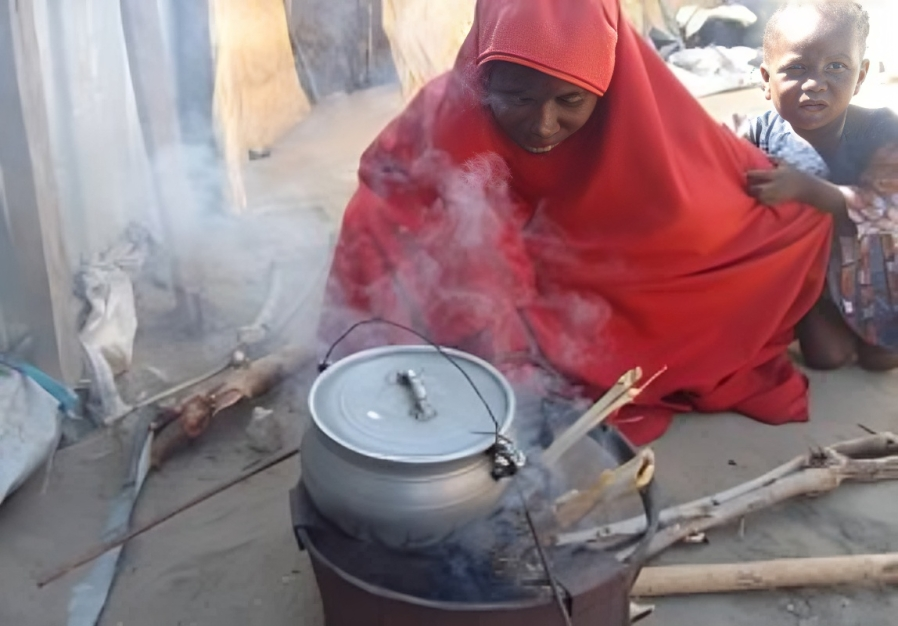
When Cooking Meant Fear
For Amina Auwali, cooking was never just about preparing meals. Living in Water Board, an IDP Camp in Monguno, North-East Nigeria, every day came with an unspoken fear that followed her family, especially her daughter. Like many displaced households, Amina depended on firewood and charcoal to cook. This meant regular trips outside the camp to collect fuel, journeys that exposed women and girls to serious protection risks, including harassment, violence, and abduction.
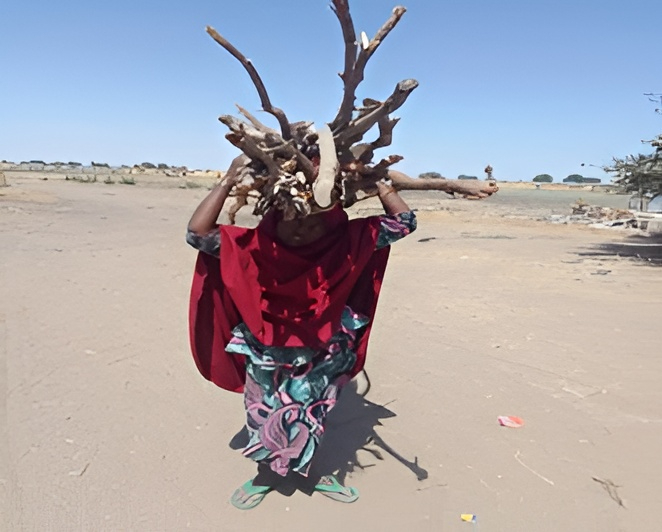
Amina’s daughter returns from the bush carrying firewood — a daily task that once exposed her to serious protection risks, and a reality many families are now working to leave behind through clean cooking. Photo by Auwal Hussaini (GISCOR).
Each time her daughter left to fetch firewood, Amina’s mind filled with worry. The danger was constant, and the anxiety was exhausting. Cooking smoke inside their shelter caused coughing, eye irritation, and chest discomfort, but even these health problems felt secondary to the fear of her child being harmed or abused.
The financial strain added another layer of pressure. The family spent between ₦6,000 – ₦8,000 (approximately $4.00 USD– $5.33 USD) per month on charcoal, funds that could otherwise support food, healthcare, or education. Cooking was not just labor-intensive; it was emotionally and economically draining.
A Simple Change, A Profound Shift
Amina first learned about solar electric cooking during a community sensitization session inside the camp, a gathering where women were invited to see alternatives to firewood and charcoal. At first, she listened with caution. For years, open fire had been the only way she knew how to prepare food for her family. Cooking without firewood felt unrealistic, even risky. Would the food taste the same? Would it cook properly? Could electricity truly replace something so familiar?
What changed her mind was not a speech, but a demonstration. She watched another woman prepare a full family meal using the ECOCA electric cooker, boiling water, cooking staple foods, and doing so without smoke or flame. Project staff explained how the appliance worked, how to use it safely, and how it could reduce the need to leave the camp for fuel. Seeing it in action, and understanding that support would be available, gave Amina the confidence to try something new.
That decision became a turning point for her household.
Once the ECOCA was installed in her home, the most immediate change was practical: there was no longer a need to collect firewood. The trips to the bush stopped. Her daughter no longer had to walk beyond the camp’s boundaries into areas marked by insecurity and fear. Cooking shifted from a task tied to risk into one grounded in safety. Meals are prepared in a smoke-free space, and the physical strain of coughing and eye irritation disappeared.
“The biggest change for me is peace of mind,” Amina says. “My daughter stays at home now. I am no longer afraid every time she leaves.”
The relief was not abstract; it was deeply psychological. For years, every cooking day carried an undercurrent of anxiety, a silent fear that something could go wrong outside the camp. With electric cooking, constant tension began to lift. The household felt calmer. Amina could focus on preparing meals without worrying about her child’s safety.
Safety That Reaches Beyond the Kitchen
The impact of electric cooking extends far beyond the stove. By eliminating the need for fuel collection, Amina’s household has significantly reduced exposure to protection risks. Her daughter now spends more time at home and in school, rather than navigating unsafe environments. As Amina explains, “Before, my daughter spent hours going into the bush to fetch firewood. Now, she can go to school and help at home safely. I no longer worry about her being harassed or hurt.” Smoke-free cooking has also improved Amina’s health, reducing coughing and eye irritation that once made long hours of cooking difficult.
Financially, the shift has also eased pressure on the household. Monthly cooking costs have dropped to less than ₦5,000 (approximately $3.30 USD), compared to the ₦6,000–₦8,000 (approximately $4.00 USD– $5.33 USD) previously spent on charcoal. Those savings, though modest on paper, represent meaningful relief in a context where every naira matters.
Beyond reducing expenses, the ECOCA system is supported through a community cost-sharing model designed to ensure long-term sustainability. Households make small monthly rental contributions. These are pooled to cover future maintenance needs, including battery replacement at the end of its lifespan, spare parts, and allowances for trained community cookstove supporters who provide ongoing technical assistance. This approach allows vulnerable families like Amina’s to access modern electric cooking technology without facing heavy upfront costs, while ensuring the system remains functional and supported over time.
The ECOCA system also provides lighting and phone charging, strengthening household safety at night and enabling the family to remain connected.
Like many users, Amina faced early challenges adapting to a new cooking method. Some meals took longer at first, and she had to adjust her routine. With practice, simple planning techniques, and continued support, solar electric cooking became part of her daily life.
Today, the transition represents something larger than energy access. It represents dignity restored. It demonstrates how clean energy solutions can serve as protection interventions, reducing risk, improving well-being, and strengthening resilience in fragile, displacement-affected settings.
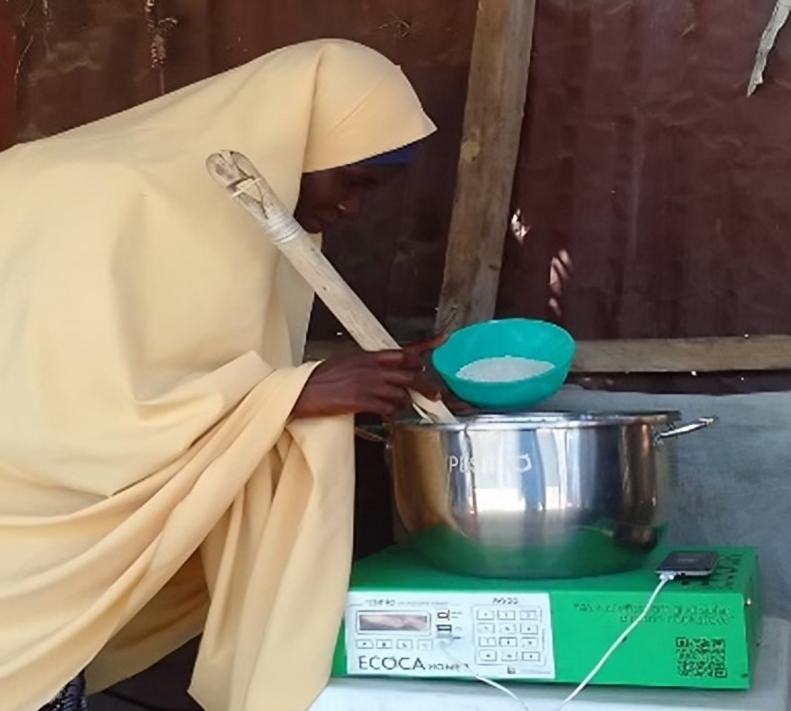
Amina Auwali cooking using ECOCA solar electric cooker that also charges her mobile phone. Photo by Auwal
Hussaini (GISCOR).
Amina’s experience illustrates a critical truth: in displacement settings, clean cooking is not only an environmental or energy solution. It is a protection strategy. It safeguards women and girls, reduces household vulnerability, improves health outcomes, and restores a sense of control and dignity in environments shaped by uncertainty.
The initiative to expand access to solar-electric cooking in Monguno is led by GISCOR in partnership with Mission East, CSR Solutions, and ECOCA ApS and supported by the SOLCO Partnership and Last Mile Climate. The initiative is funded by the Danish Ministry of Foreign Affairs, the MECS Programme at Loughborough University, the IKEA Foundation, and the Robert Bosch Foundation.